2 – Juno
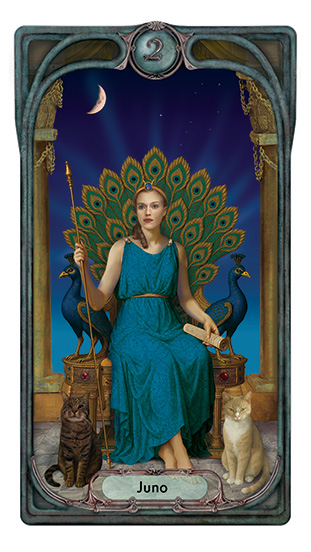
This card is sometimes called the High Priestess, relating to the deities Isis or Athena. As the Priestess, she represents hidden knowledge, divine authority, and the mysteries of the night. She is often veiled and holds a closed book, reflecting mysticism and occult knowledge. I acknowledged this interpretation with a crown of Hathor, which was later adopted by Isis, and the two sacred guardian cats.
However, I prefer the alternative assignment of “Juno” because it relies more on mythology than modern organized religion. Juno’s symbolism emphasizes structure, legitimacy, and the conscious acceptance of responsibility rather than secrecy or hidden knowledge. As queen of the Roman gods, she governs marriage, oaths, and social bonds that are entered into in the temporal world. She lives in the realm between night and dawn, when the sun begins to light the horizon and the stars and planets in the night sky begin to fade, but are still visible.
Rather than withholding knowledge, she brings truth and accountability into the light of day. Writing can be seen on the scroll she holds loosely in her hand, implying that it is available to anyone.
The peacock is central to the mythology of Juno, with the eyes of the peacock’s tail seeing all. This symbolism is the basis of the design I chose for her throne and for the color of her gown. The peacock reference is repeated in the constellation Pavo, named for the peacock, faintly visible in the top right corner of the card.
In the interpretation I chose to base my card on, Juno sits between the twin pillars of Solomon’s Temple, symbols of divine strength and stability. Although there is no visual record of Solomon’s Temple, the columns are described as being constructed of metal, and decorated with lilies, pomegranates, latticework, and chains. I based my version on an architectural model designed by Thomas Newberry on display at the Metropolitan Museum of Art.
This card presented a conflict for me because one of my goals in creating this deck was to avoid religious references, specifically the idea that a human can wield divine power. However, today Greek and Roman deities are generally regarded as mythological figures, and I feel they serve as powerful archetypes that transcend any particular time, place, or belief system. In the same way, the inclusion of the Temple of Solomon is intended as a historical rather than a religious reference.



Kickstarter Campaign Launched October 1, 2026
Thank you for your interest in this campaign. Visit it on Kickstarter for updates.