WIP: The Court Cards
Establishing the Roles
There are sixteen Court Cards in the Tarot, four for each suit, but their roles and relationships vary considerably between traditions. Depending on the tradition, they may appear as combinations of King, Queen, Prince, Princess, Knight, Page, or Valet. In the Crowley–Harris Thoth deck the sequence is Knight – Queen – Prince – Princess, while the Rider–Waite tradition uses King – Queen – Knight – Page.
These titles loosely correspond to the royal cards in a standard deck of playing cards, but there is an important distinction: in playing cards, hierarchy matters mechanically within the game itself. In Tarot, hierarchy is far less important because the Court Cards do not compete for rank or power. Each represents a distinct mode of energy, temperament, perspective, or engagement with the suit.
Because there is no universally accepted convention for the Court Cards, I felt free to establish my own system. I prefer the familiar playing-card structure of King and Queen, partly because it provides a useful artistic and archetypal framework, though I do not treat these roles as rigidly gendered. In my interpretation, the King and Queen are equals. Tarot is not concerned with physical dominance or social authority in the ordinary sense, and I do not see one as inherently more powerful than the other. They simply embody different expressions of mastery within the suit.
The same principle applies to the Prince/Princess and Knight. I may choose either masculine or feminine archetypes depending on the needs of a particular card, and I am comfortable allowing that variation to exist naturally within the deck. The distinction is symbolic rather than prescriptive.
I chose to retain the Knight because, although the figure belongs to an older world of imagery and mythology, the archetype still carries a distinctive energy: movement, pursuit, risk, conviction, and directed force. As with the other Court Cards, gender itself is ultimately secondary to the psychological and symbolic role the figure represents.
Bridging the Two Arcana
The Court Cards occupy an unusual position in the Tarot. They are more symbolically significant than the numbered suit cards, yet less archetypal and monumental than the cards of the Major Arcana. At the same time, unlike the numeric cards, they represent people. This places them visually and symbolically between the two arcana.
That presented a difficult artistic challenge. In the Minor Arcana I intentionally moved away from the highly representational, human-centered imagery of the Majors in favor of a more abstract and structured numeric system. The Court Cards required me to reintroduce human figures without abandoning the visual language already established by the suits.
At the same time, I did not want the Court Cards to become miniature Major Arcana cards. If rendered with the same level of environmental detail and symbolic density, they would overwhelm the more restrained visual structure of the Minor Arcana and weaken the distinction between the two systems.
My solution was to simplify both the figures and their environments while preserving realism and psychological presence. Rather than placing the characters within fully realized narrative scenes, I’m embedding them into the dark, color-coded atmospheric fields already established for the suits. This allows the Court Cards to retain continuity with the numeric cards while still introducing recognizable human archetypes.
I also found that this restraint strengthened the symbolic clarity of the Court Cards. By reducing environmental complexity and avoiding excessive decorative symbolism, the viewer’s attention is drawn more directly toward the psychological presence of the figure itself. The meaning emerges less from hidden objects or elaborate narrative scenes and more from posture, expression, gesture, atmosphere, and implied experience. In this way, the Court Cards become studies of embodied human energy rather than densely coded allegorical illustrations.
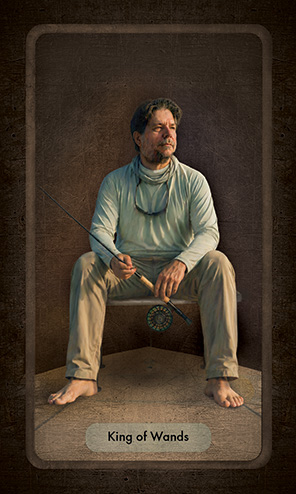
The King of Wands illustrates this approach. The figure is rendered realistically and grounded in authentic details drawn from the world of shallow-water fly fishing in the Florida Keys, reflecting the mastery, confidence, and directed energy associated with the suit. However, the environment surrounding him is intentionally reduced and partially abstracted. The atmospheric background retains the warm bronze and earth tones of the Wands suit while avoiding the elaborate scenic realism typical of the Major Arcana.
The result is a hybrid visual language: more human and psychologically specific than the numbered cards, but more restrained and atmospheric than the Major Arcana. In this way, the Court Cards function as a bridge between the two worlds.
court cards