WIP: The Minor Arcana
Establishing the Language
The design of the pip cards begins with a constraint: the images must remain clear, legible, and scalable as the numbers increase.
The Ace establishes the visual identity of the suit. After that, ornament is reduced and structure takes priority. Each subsequent number is built by arranging the suit symbols in ways that express relationship, not decoration.
The Numeric Structure
The deeper structural logic behind the numbers is explained separately, but here the focus is on how that logic becomes visible.
| Number | Dialectical Role | Core Function |
| 1 | Thesis of Thesis | Emergence, raw potential, definition |
| 2 | Antithesis of Thesis | Tension, contrast, destabilization of the new |
| 3 | Synthesis of Thesis | Stabilization, viability, coherence |
| 4 | Thesis of Antithesis | Structure, containment, limits appear |
| 5 | Antithesis of Antithesis | Stress, conflict, breakdown under pressure |
| 6 | Synthesis of Antithesis | Adjustment, accommodation, functional balance |
| 7 | Thesis of Synthesis | Reorientation, renewed effort, integration begins |
| 8 | Antithesis of Synthesis | Refinement, friction within improvement |
| 9 | Synthesis of Synthesis | Maturity, fulfillment, sustained function |
| 10 | Final Synthesis | Closure, consolidation, system complete |
This table describes what the number does, not what it “means.”The suit tells you where this function is operating.
Background Color System
The background tints provide a subtle but consistent visual cue for each suit, reinforcing their domain without competing with the central imagery. Rather than relying on overt symbolism, the colors operate as an ambient layer of meaning, immediately orienting the viewer while allowing the structure of the card to remain primary.
Each suit is assigned a color that reflects its underlying nature:
- Wands — Yellow
Yellow carries the qualities of light, heat, and activation. It suggests energy in motion, initiative, and outward expression. As a background tint, it supports the sense of ignition and expansion without overwhelming the form of the wand itself. - Coins — Green
Green reflects growth, material life, and continuity. It evokes the natural cycles of accumulation and renewal—resources that develop over time. This makes it an appropriate field for the Coins, grounding the imagery in the domain of the tangible and the enduring. - Cups — Blue
Blue suggests depth, fluidity, and emotional resonance. It carries associations with water, reflection, and interior states. The tint creates a quiet, immersive field that supports the relational and affective nature of the suit. - Swords — Violet
Violet occupies a boundary space between clarity and abstraction. It suggests intellect, tension, and transformation at the level of thought. As a background, it provides a slightly unstable, charged atmosphere appropriate to the cutting and analytical nature of the suit.
Across all suits, the colors are intentionally subdued and integrated into the texture, rather than applied as flat fields. This allows them to unify the deck visually while remaining secondary to the structural compositions of the cards.
The Aces – Identity
The Aces introduce the suit in its purest form.
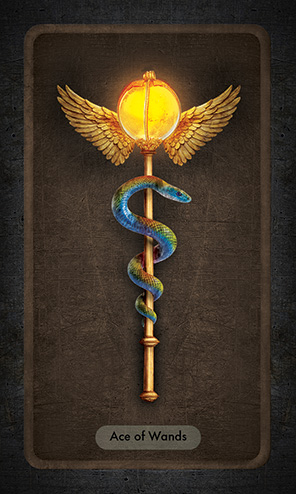
Ace of Wands 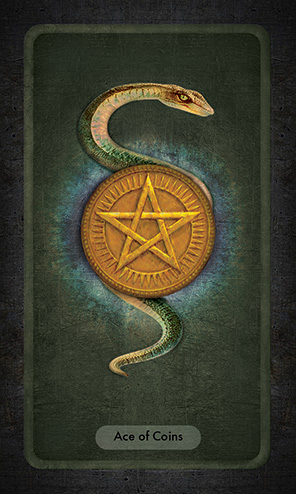
Ace of Coins 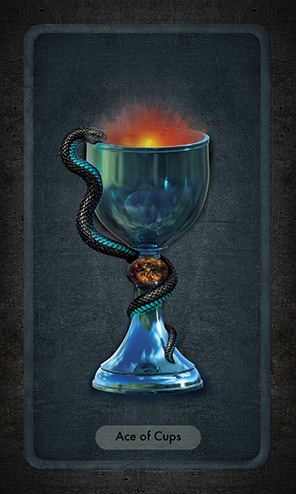
Ace of Cups 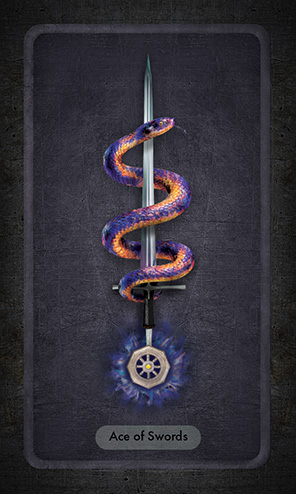
Ace of Swords
Each Ace presents a single, dominant symbol, fully realized and slightly embellished. This is the only point in the suit where the symbol is allowed to feel expansive and mythic.
The inclusion of the serpent serves two purposes:
- it reinforces the sense of emergence and latent energy
- it connects the Minor Arcana visually to the Major Arcana
After the Ace, the system takes over, and this level of ornament does not persist.
The Twos — Division
The Twos introduce separation.
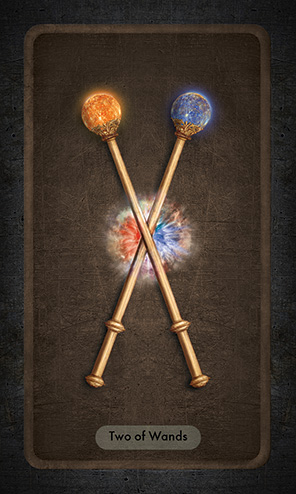
Two of Wands 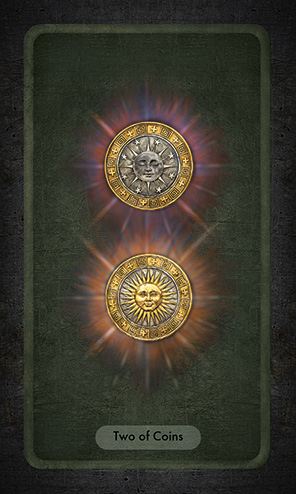
Two of Coins 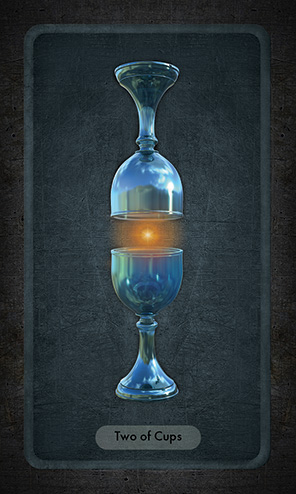
Two of Cups 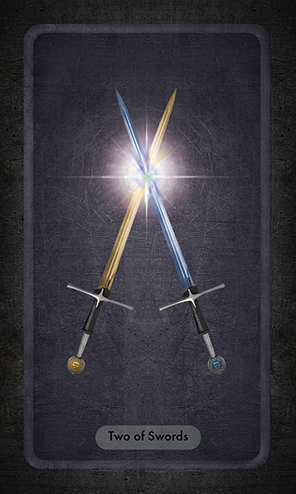
Two of Swords
A single force becomes two, and tension appears for the first time. The design challenge is to show opposition without clutter.
Each suit expresses this differently:
- rigid elements cross or collide
- fluid or material elements mirror or oppose
In the Coins, this becomes a polarity between sun and moon—two distinct states of value that exist simultaneously but do not yet reconcile.
The composition is deliberately simple:
- two objects
- a clear axis
- separation maintained
The Threes — Structure
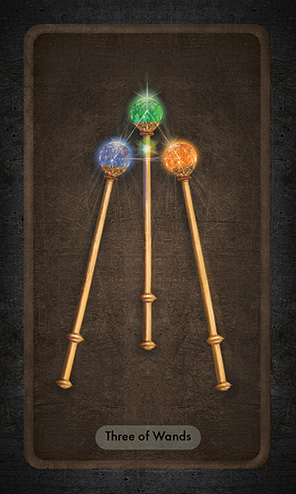
The Threes move beyond opposition into relationship.
Three of Wands 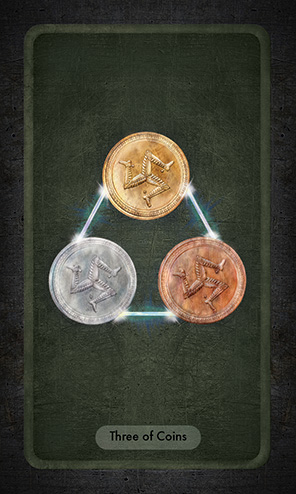
Three of Coins 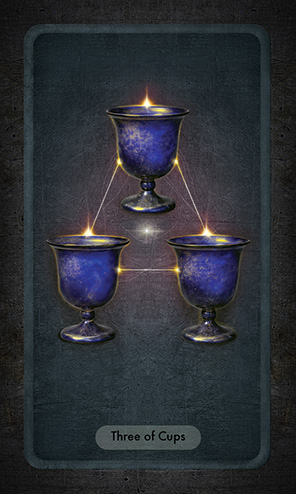
Three of Cups 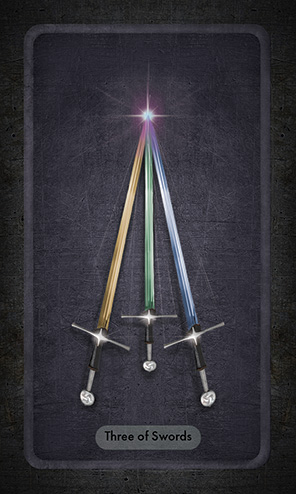
Three of Swords
Three elements allow for the first stable structure, most naturally expressed as a triangle. This introduces:
- interdependence
- continuity
- system behavior
In the Coins, the triangle is paired with a circular flow, suggesting that value is not static but moves through a network.
At this stage, the cards begin to feel less like arrangements and more like mechanisms.
The Fours — Containment
The Four stabilizes the system.
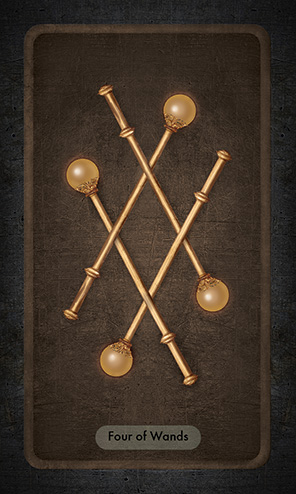
Four of Wands 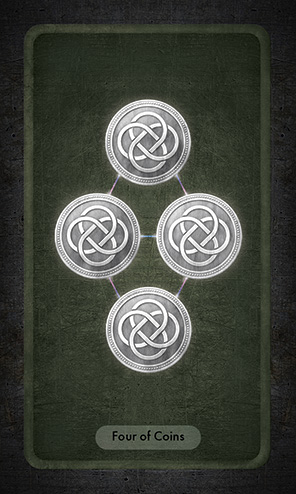
Four of Coins 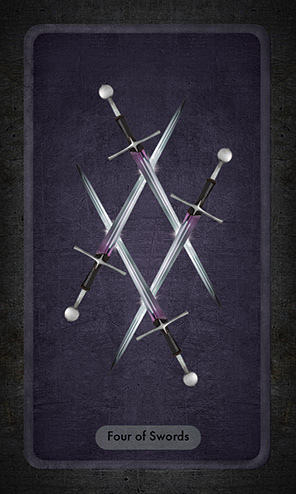
Four of Swords
The dynamic relationships of the Three are fixed into a more rigid form. This often appears as:
- square geometry
- evenly spaced elements
- reduced motion
The emphasis is on holding and preserving, rather than interacting.
The Fives — Disruption
The Five breaks what the Four has established.
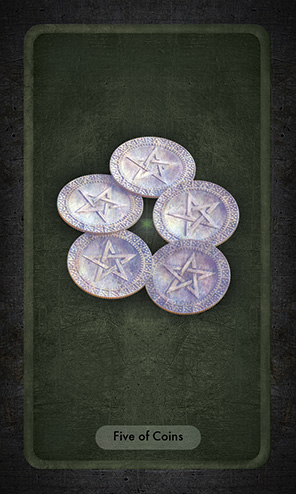
Five of Coins
The design reflects this through:
- imbalance
- misalignment
- interruption of pattern
Where the Four is stable, the Five is unstable. The system shows strain.
The Sixes — Adjustment
The Six restores balance, but not by returning to the Four.
Instead, it introduces managed exchange. The elements remain distinct, but their relationships are adjusted.
Visually, this often appears as:
- asymmetrical balance
- controlled flow
- redistribution
The Sevens — Evaluation
The Seven introduces hesitation and assessment.
The system holds, but its effectiveness is questioned. This is expressed through:
- incomplete patterns
- tension within a stable structure
- implied delay
The Eights — Process
The Eight focuses on repetition and refinement.
The design emphasizes:
- rhythm
- iteration
- consistent spacing
The system is now functioning through effort and repetition.
The Nines — Completion
The Nine represents a system that is nearly complete.
The elements are:
- well integrated
- stable
- internally coherent
There is a sense of fullness without overcrowding.
The Tens — Saturation
The Ten completes the cycle.
The structure reaches its limit and becomes dense. This is expressed through:
- full occupation of space
- layered or compact arrangements
- reduced negative space
At this point, the system is no longer developing. It is concluding, and preparing to give way to something new.
Closing Note
The goal of these designs is not to illustrate scenes, but to make structure visible.
Each card is intended to function as a clear, readable configuration of forces, so that meaning emerges from the relationships on the card itself, rather than from external narrative.
numeric system