WIP: 8 – Justice
Justice is proving to be one of the more difficult cards for me to resolve, precisely because it appears, at first glance, to be so straightforward. Traditionally, Justice is represented by a woman holding a balance scale and a sword, sometimes blindfolded. This iconography has remained remarkably stable across centuries, which should, in theory, make the card easy to design.
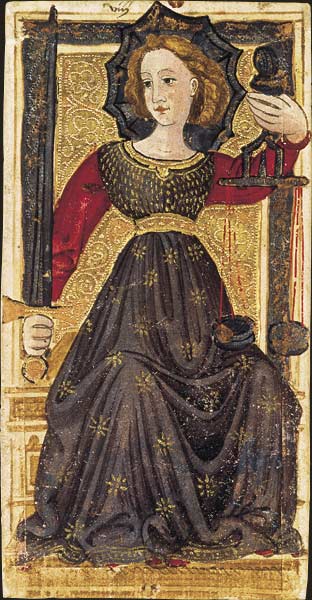
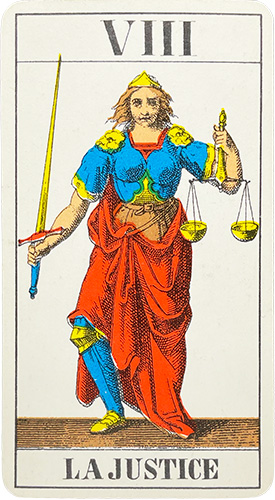
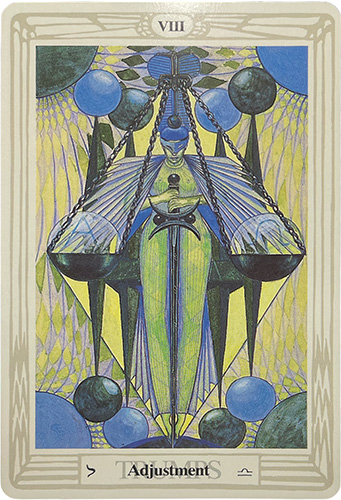
Paradoxically, that stability is the problem. The scale and sword feel settled to the point of cliché. Reproducing them would be historically correct, but conceptually inert. For this project, I am not interested in preserving imagery simply because it is familiar. I want the card to speak meaningfully to the world I live in now.
The sword made sense in earlier eras. In medieval Europe, justice was often swift, brutal, and literal. Capital punishment was common, and the sword was not just a symbol of judgment but a tool of execution. In that context, the sword accurately represented how justice was enacted.
I do not believe that metaphor holds today.
For me, justice should be slow, deliberate, and measured. It should focus on restoring balance and repairing harm rather than inflicting punishment. Punishment may satisfy anger, but it doesn’t heal. A sword implies finality and force; neither aligns with how I understand justice in a modern, human context.
Another difficulty lies in the figure of the judge itself. Traditional imagery suggests that a single, wise authority presides over justice with clarity and probity. Contemporary history makes it hard to accept that premise uncritically. Individuals and institutions entrusted with judgment are subject to bias, corruption, and power. In many cases, injustice is not the result of individual wrongdoing alone, but of systems that perpetuate inequality over time.
For this reason, I find myself moving away from a narrowly individual concept of justice and toward a broader idea of social justice. When injustice is woven into the fabric of a society—its laws, customs, and assumptions—it cannot be corrected by force or decree. It requires sustained cultural change: a reexamination of values, beliefs, and behaviors across generations.
I am strongly drawn to Nelson Mandela as a model for Justice. His conception of justice was not rooted in vengeance, nor in speed. It was patient, restrained, and oriented toward the possibility of a future rather than the satisfaction of punishment for past wrongs. He understood that accountability could coexist with mercy, and that justice achieved through cruelty ultimately corrodes itself.
Underlying this choice is a concept that resonates strongly with me: justice is not swift, and it is not simple. The often-quoted line, “The arc of the moral universe is long, but it bends toward justice,” captures this tension well. Whether that arc bends inevitably or only through human effort is an open question—but history suggests that justice, when it arrives, does so through endurance, patience, and the slow transformation of collective consciousness.
This card is still taking shape. What I know is what I want to leave behind: the sword as a symbol of power and punishment, the illusion of impartial blindness, and the fantasy of the scales weighing both sides equally. What I am working toward is an image of justice as something fragile and ongoing—less an event than a commitment, sustained over time by human effort rather than imposed by authority.
Instead of being seated on a throne, I want my figure to be in a landscape that shows the weathering of time but also speaks of endurance. Mandela was known for his colorful Madiba shirts that express the joy and freedom that was denied him during his imprisonment and to honor the cultural traditions of his South African heritage, so that will have to be part of the imagery as well. Rather than mimic an existing pattern without understanding its references and meaning, I decided to instead pay homage to the traditions of this garment by drawing on the visual language of Mandela’s Madiba shirts, reinterpreting it through original patterning to express justice as patience, balance, and restraint.
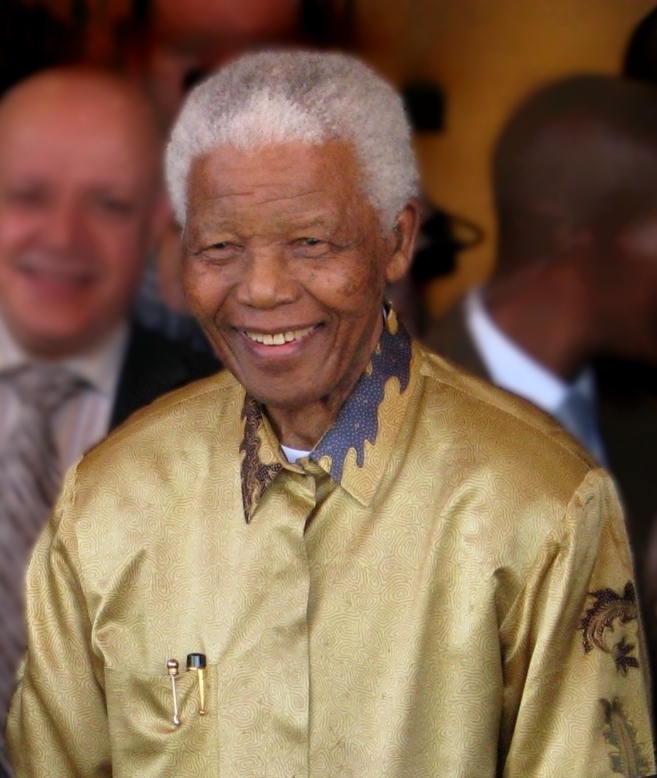
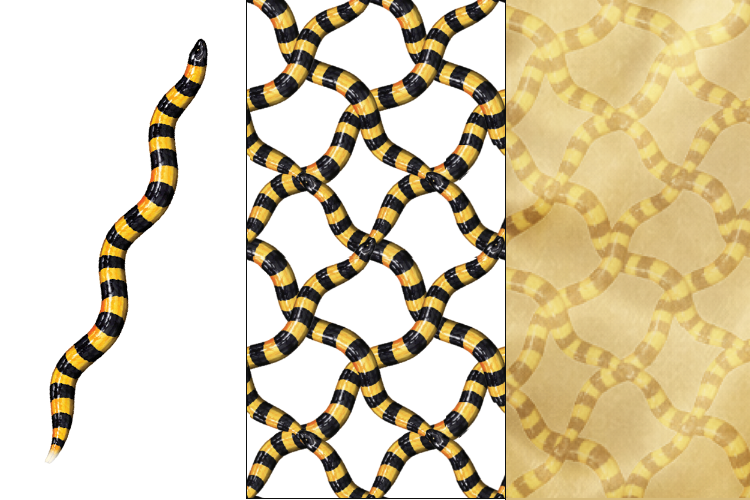
Using an AI generated Cape coral snake, which is indigenous to South Africa, I wove it into a seamless repeating pattern for the Madiba that suits the style of the garment but also echos the snake symbol that is present in each card of the Major Arcana. I then applied that to a textured base and used it to construct the shirt.
*This file is licensed under the Creative Commons Attribution-Share Alike 3.0 Unported license.
