WIP: The Minor Arcana
Establishing the Language
Designing the pip cards begins with a practical constraint: as the numbers increase, clarity must be preserved. I did not want the meaning of the card to rely on additional imagery because I felt that it would both obscure and limit the interpretation of the card. Since my system relies on the numbers themselves for meaning, the structure of the cards’ symbols and their relationship to each other is foundational and should not be obscured or used merely as props in a complex tableau.
Lower numbers allow for singular, highly resolved symbols. As the sequence progresses, the cards rely less on individual form and more on the pattern those forms create together. Meaning is carried by arrangement rather than ornament.
The design problem is consistent across the suit: preserve the identity of the symbol while allowing the number to determine the structure.
The Numeric Structure
The deeper structural logic behind the numbers is explained separately, but here the focus is on how that logic becomes visible.
| Number | Dialectical Role | Core Function |
| 1 | Thesis of Thesis | Emergence, raw potential, definition |
| 2 | Antithesis of Thesis | Tension, contrast, destabilization of the new |
| 3 | Synthesis of Thesis | Stabilization, viability, coherence |
| 4 | Thesis of Antithesis | Structure, containment, limits appear |
| 5 | Antithesis of Antithesis | Stress, conflict, breakdown under pressure |
| 6 | Synthesis of Antithesis | Adjustment, accommodation, functional balance |
| 7 | Thesis of Synthesis | Reorientation, renewed effort, integration begins |
| 8 | Antithesis of Synthesis | Refinement, friction within improvement |
| 9 | Synthesis of Synthesis | Maturity, fulfillment, sustained function |
| 10 | Final Synthesis | Closure, consolidation, system complete |
This table describes what the number does, not what it “means.”The suit tells you where this function is operating.
Background Color System
Each suit is placed within a consistent tonal field. These backgrounds are not decorative, but environmental. They provide a stable visual context that supports the suit without competing with it. In a reading they should provide an almost subliminal cue and a subtle differentiation.
Wands are set against yellow, reinforcing projection, ignition, and outward movement.
Coins are set against green, grounding the suit in material persistence and continuity.
Cups are set against blue, establishing depth, flow, and receptivity.
Swords are set against violet, introducing tension, differentiation, and analytical clarity.
Creating the Art
I began the art for the suits by creating unique objects in Photoshop, but as I progressed to more elaborate arrangements I realized I would need to account for interaction in three-dimensional space, including complex perspective angles, reflections and light direction. In addition, the objects themselves needed to be similar without being identical and also be able to vary when necessary for contrast. These design criteria could only be met by using three-dimensional models.
Beginning at the fours I began modeling my objects in Blender, then moved them into DazStudio where I arranged them, applied materials to their surfaces, lit them, then rendered the finished layout. From there they went into Photoshop for detailing and compositing to complete the card. This switch necessitated redoing all the previous cards to reflect the improved realism and surface quality of the object.
The cups benefitted most from the switch from 2D to 3D, since their reflections and lighting are very complex. It is impossible to move past a static arrangement with them if perspective is not introduced, and that perspective is impossible to create realistically from a flat image.
The coins, on the other hand, are fairly simple to put into perspective manually from a two-dimensional model. The problem with them was pattern and lighting. Since the coin faces are raised, each coin has a unique set of highlights and shadows. I also wanted to change the coin faces to reflect the number progression, which meant I would have to build many sets of coins, while making the coins in each set both identical and unique, as they are minted identically but wear and age individually. I could not do this efficiently in Photoshop while maintaining a high level of realism.
I started with a line drawing of the coin face in Illustrator, then applied it to a flat cylinder shape in Blender to create the coin. Although it was a painstaking process to get the pattern of the coin drawn with the correct pattern and symmetry, the results were worth it.

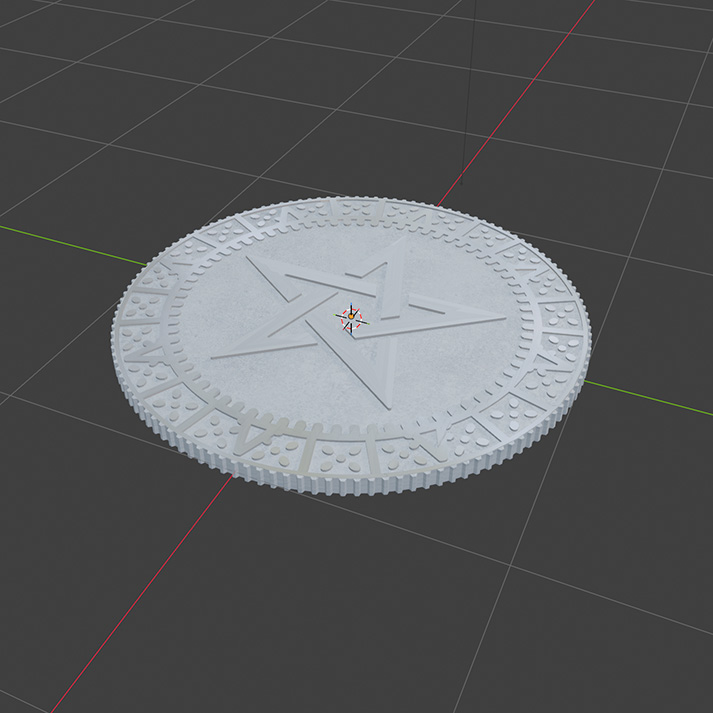
In Blender I applied various surface treatments to enhance the shading, metallicity and reflectivity of the coin’s”s surface. The rendered layout was then brought into Photoshop where I refined the lighting, shadows and surface color and texture to achieve the exact look I wanted.
The Aces – Identity
The Aces establish the identity of each suit in its most exultant form.
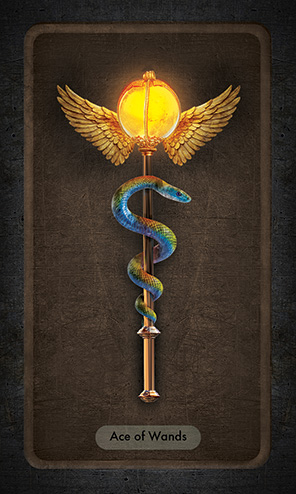
Ace of Wands 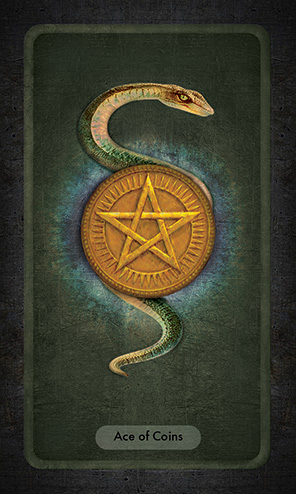
Ace of Coins 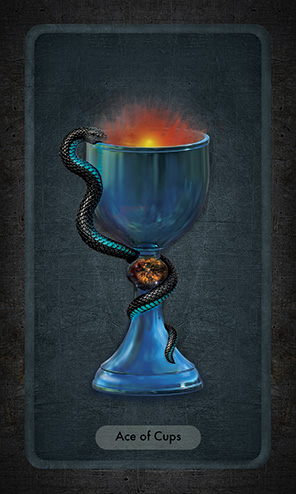
Ace of Cups 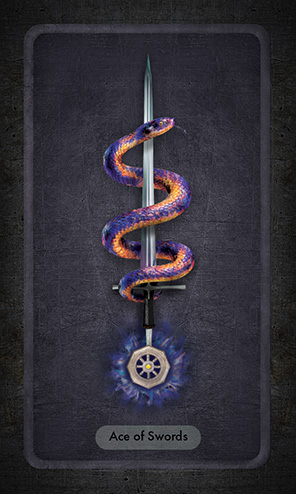
Ace of Swords
Each presents a single symbol, fully realized and given a level of detail that will not continue into the rest of the sequence. This is the only point where the suit is allowed to appear singular and expansive without structural constraint.
The serpent is included here to connect the Minor Arcana visually and symbolically with the Major Arcana. Once that connection is established, it is no longer necessary in later cards.
The Twos — Division
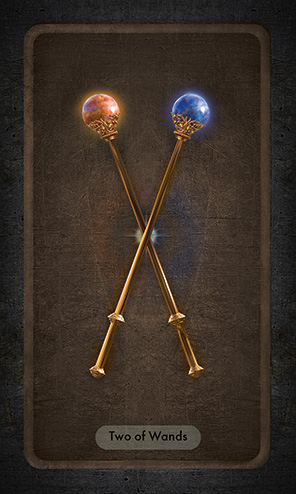
The Twos introduce division.
Two of Wands 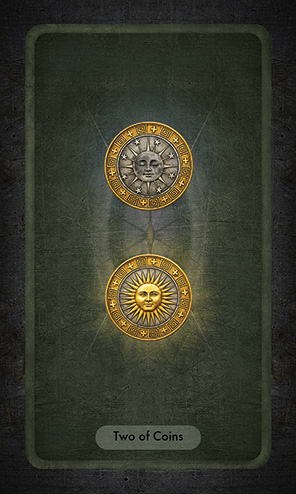
Two of Coins 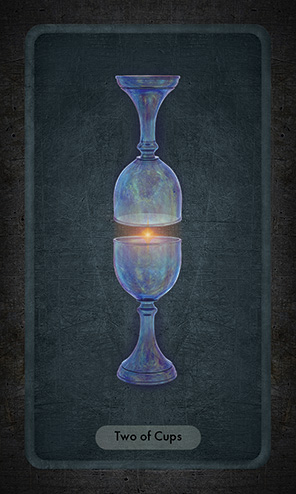
Two of Cups 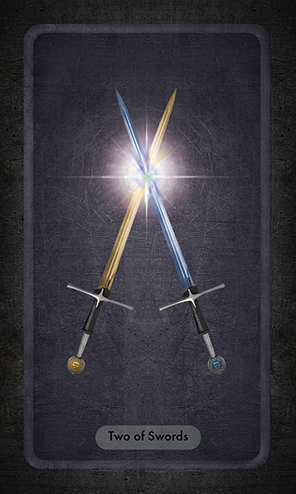
Two of Swords
Two elements are placed in direct relationship, establishing opposition without resolution. The composition is clear and minimal: two forms with either direct opposition or visible separation.
The emphasis is not on complexity, but on contrast. The card is defined by tension.
The Threes — Structure
The Threes establish structure.
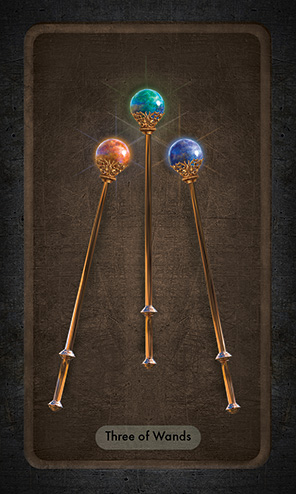
Three of Wands 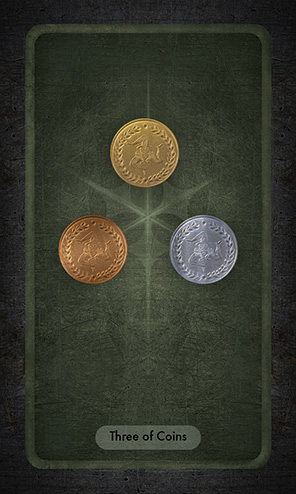
Three of Coins 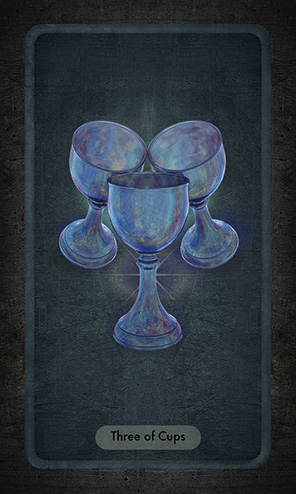
Three of Cups 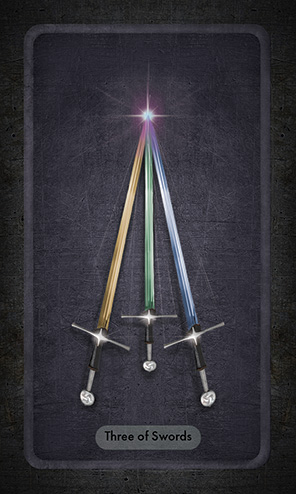
Four of
With three elements, the composition can move beyond opposition and begin to form a system. The arrangement feels unified, with each element participating in a shared relationship.
Triangular geometry is effective here, as it creates coherence without rigidity. The stability of the triangle reinforces the resolution of the first dialectical set. The card should no longer read as separate objects, but as a connected configuration: three working towards one.
The Fours — Stabilization
The Fours stabilize the structure.
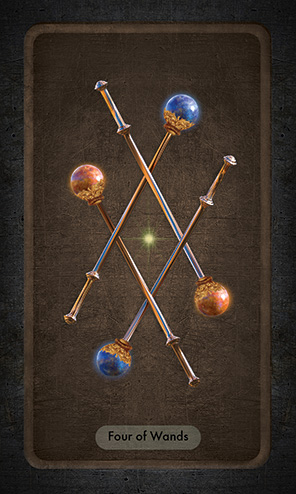
Four of Wands 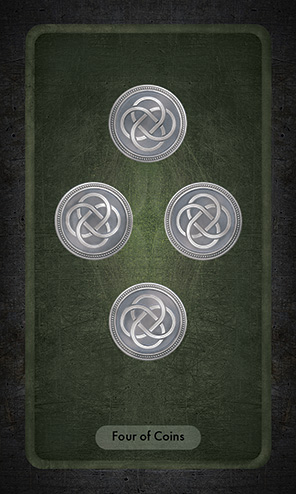
Four of Coins 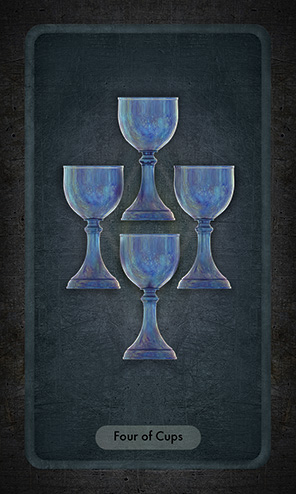
Four of Cups 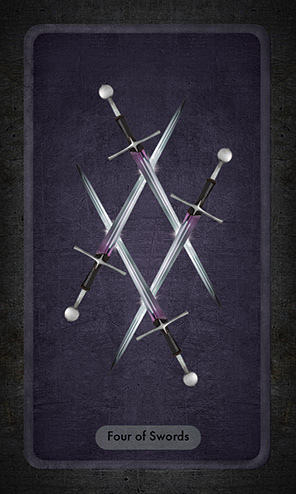
Four of Swords
The system becomes fixed, consistent, and resistant to change. The composition feels contained and controlled, with reduced motion and clear spacing. The coins reflect this in the endless knots on their faces.
This is a point of structural rigidity. The arrangement holds its form by limiting variation.
The Fives — Disruption
The Fives disrupt the structure.
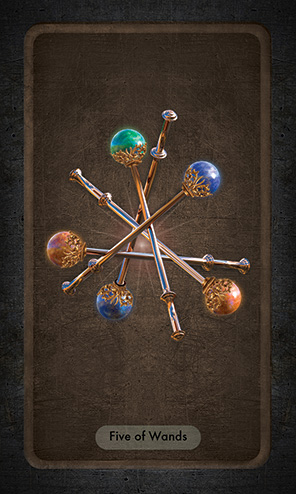
Five of Wands 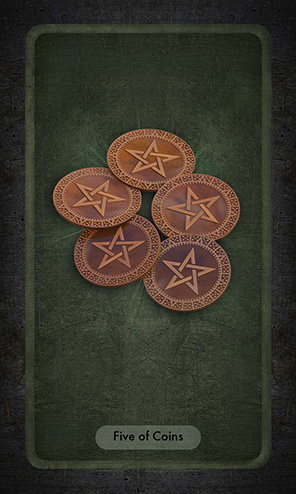
Five of Coins 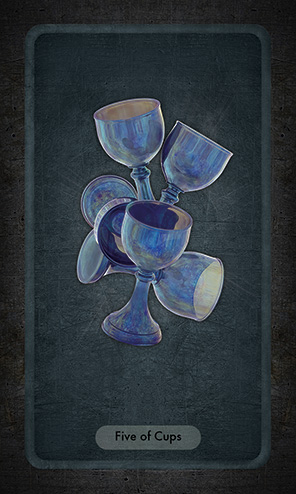
Five of Cups 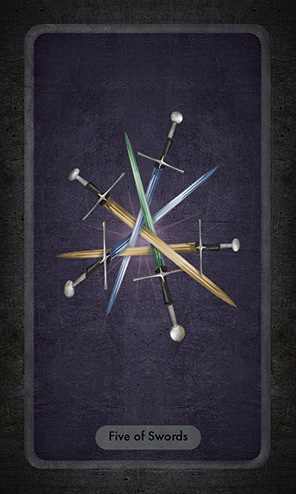
Five of Swords
The five is a a card of conflict and scattered energy, so rather than continue the pattern of geometric alignment seen earlier in the suit, the elements clash and overlap. An element of disorganization or chaos is introduced.
The Sixes — Adjustment
The Sixes restore coherence.
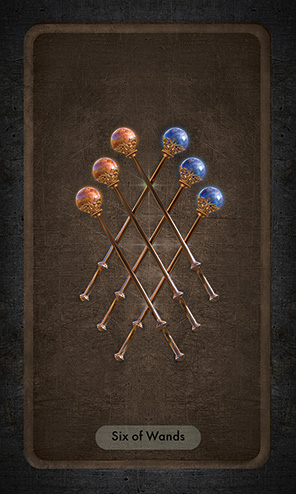
Six of Wands 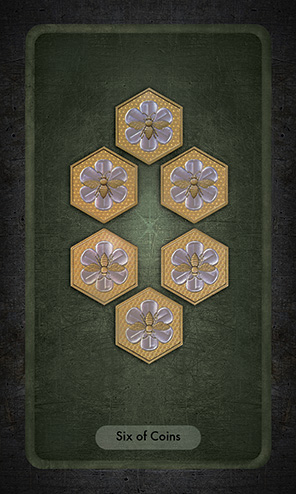
Six of Coins 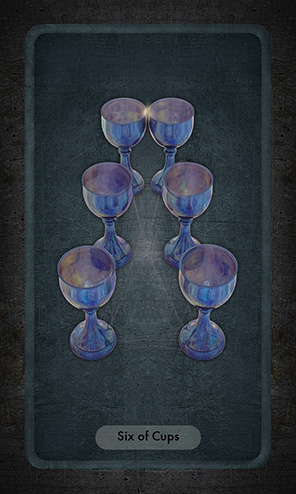
SIx of Cups 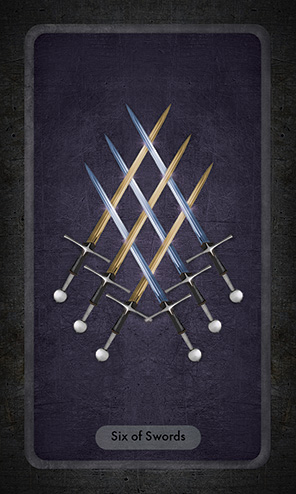
Six of Swords
The system reorganizes and resolves internal conflict, forming a stable but active arrangement. Relationships are balanced rather than rigid.
Lattice structures, reciprocal spacing, and controlled symmetry are effective here. The composition eels stable, but not static. The pattern for the remaining cards of each suit is established, whith the wands and swords following a woven pattern, the coins arrayed in geometric patterns to match their numbers and the cups arrayed in perspective.
The Sevens — Evaluation
The Sevens mark the beginning of synthesis.
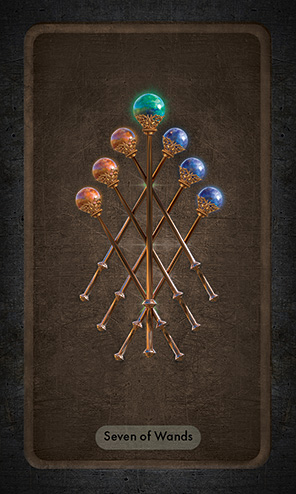
Seven of Wands 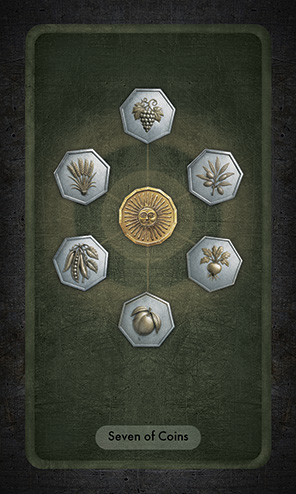
Seven of Coins 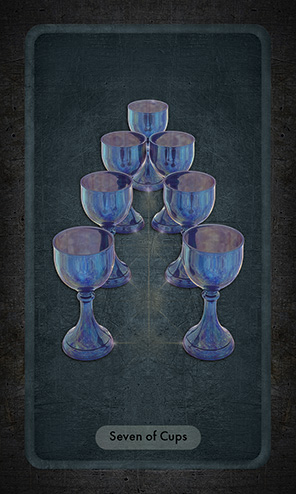
Seven of Cups 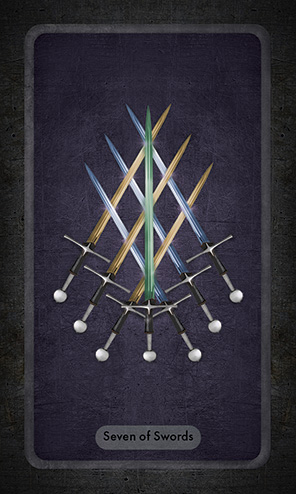
Seven of Swords
A new order begins to emerge. Elements align toward a shared direction, establishing a developing hierarchy. This is the stage where the coins begin to differentiate in their faces to express meaning that transcends the symmetrical arrangement. Since they can not be linked physically like the wands and the swords I chose to link them symbolically with the images on their faces. My Seven of Coins depicts six crop foods surrounding a sun, representing patience, long-term investment, and progress which will be rewarded.
The structure is not yet fully balanced, but it is no longer unstable. The composition is directed and concentrated, with increasing coherence around the dominant axis or organizing principle.
The Eights — Process
The Eights express movement.
Eight of Wands 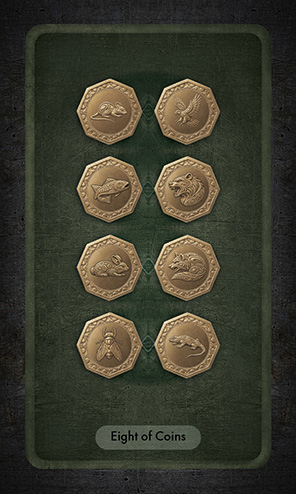
Eight of Coin 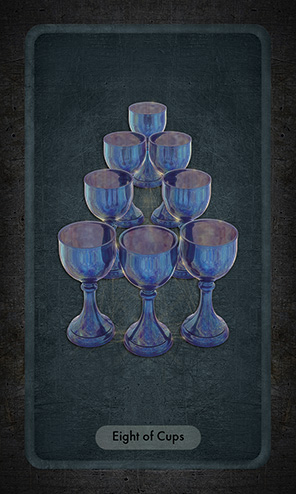
Eight of Cups 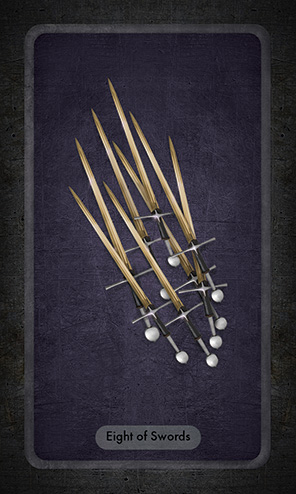
Eight of Swords
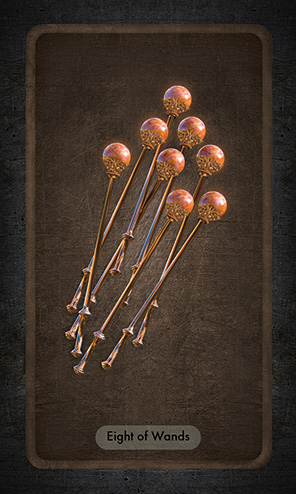
The system extends outward and operates through repetition and momentum. The composition is directional rather than centralized.
Process is expressed in different ways depending on the nature of the suit. The wands and swords continue to mirror each other, with the emphasis on directionality and movement. The coins create a subtle tension by pairing sets of predators and prey, creating a back-and-forth tension between the two columns. The cups have little opportunity for complex relationships due to their size and, keeping with the gentler nature of the suit, they simply evolve toward their ultimate resolution.
The Nines — Stabilization
The Nines stabilize at a higher level.
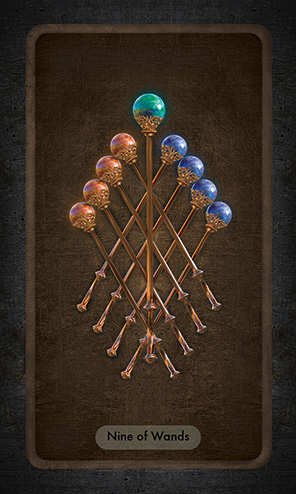
Nine of Wands 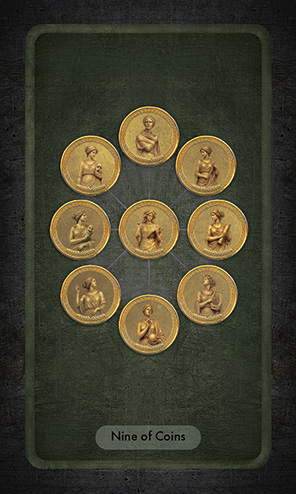
Nine of Coins 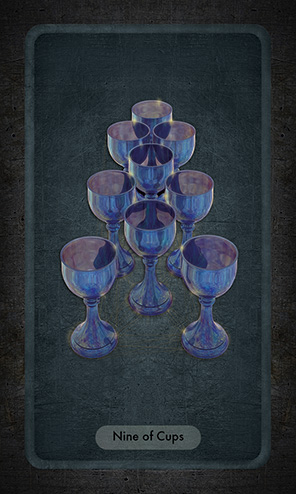
Nine of Cups 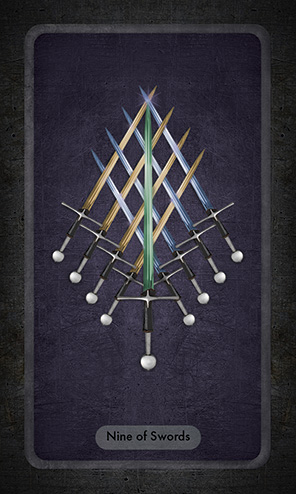
Nine of Swords
The elements are well integrated, stable, and internally coherent. In the wands and swords a stronger central element dominates, both its size and color reflecting the strong synthesis of this suit. The coins are harmonious in style and color, although each has a different image on its face. The faces show each of the nine Muses from Greek mythology, with Calliope, the eldest and wisest in the center.
There is a sense of fullness without overcrowding.
The Tens — Completion
The Tens complete the cycle.
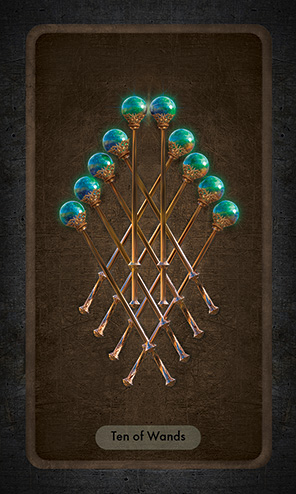
Ten of Wands 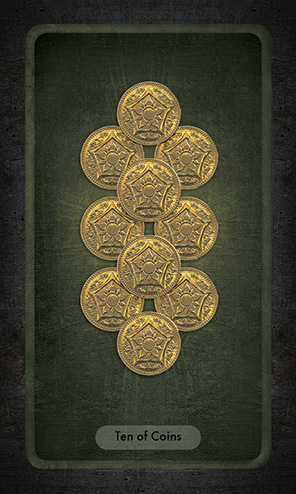
Ten of Coins 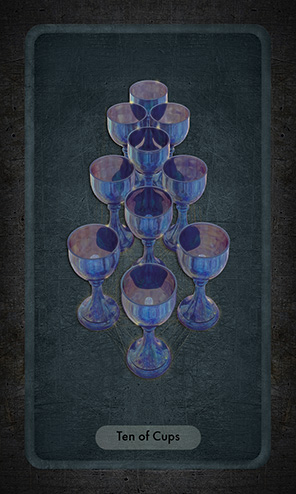
Ten of Cups 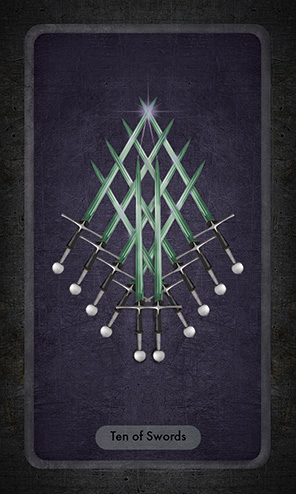
Ten of Swords
The system reaches full integration and occupies its structure completely. The composition becomes dense and conclusive, with reduced negative space.
The challenge here was to maintain clarity while conveying fullness. The card feels resolved, not overcrowded. Color variation and variation has been reduced to signal unity. The green color of the the wands and swords symbolize the removal of opposition, which had previously been represented in the contrasting colors of blue and orange or yellow. The wands show a transcendence, with the upward placement of the center rods. The swords show a meeting at the top, closing the tension and containing the sharp tips in a point of shared energy. The coins are identical and the cups are organized in a tight arrow formation.
Closing Note
The goal of these designs is not to illustrate scenes, but to make structure visible.
Each card is intended to function as a clear, readable configuration of forces, so that meaning emerges from the relationships on the card itself, rather than from external narrative.
numeric system