Conception of the Card
Each card in the Major Arcana demands sustained attention and deliberate planning. I am rarely focused on a single card in isolation. Typically, I have two cards in active conceptual development while I am executing a third. This overlap gives me the necessary distance and time to research a card’s historical lineage, symbolic vocabulary, and traditional interpretations, and then to test those materials against my own evolving vision.
During this phase, much of the work is internal. I ask how the card’s themes intersect with my own lived experience and how its symbolic structure can be expressed without relying on inherited imagery or clichés. This is not a matter of illustration, but of interpretation.
Very early in the process, I usually identify a specific persona for the card. This figure is not chosen for likeness alone, but for the qualities they embody. The persona serves as an anchor, helping me translate abstract ideas such as authority, rupture, restraint, or insight into a human presence that feels grounded and intentional. At this stage, I make handwritten notes about the direction I intend to take and produce a quick, rough sketch of the card’s overall layout.
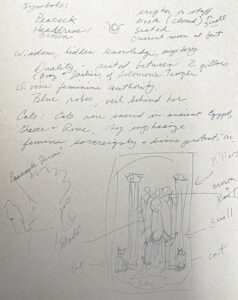
From there, I mentally explore multiple compositional possibilities. I rehearse different spatial arrangements, gestures, and symbolic emphases until one configuration clearly communicates what I intend the card to say. Only when that internal structure feels resolved do I move into execution. At that point, Photoshop becomes a tool of realization rather than experimentation, allowing me to give concrete form to a vision that has already been carefully constructed.
Although I generally work through the Major Arcana in ascending order, I occasionally jump ahead. This happens when I arrive at a particularly strong vision for a card, when I am inspired by a person or event in my life, or when the next card in sequence has not yet clarified itself but a later one has. For some cards, the vision is sufficiently compelling that I move directly into execution, regardless of its position in the deck.
The imagery becomes more demanding as the sequence progresses, largely because of the inherent structure of the Major Arcana itself. The earlier cards tend to be conceptually simpler, relying on single figures and relatively direct symbolic relationships. Their meanings are more concrete and easier to localize within a single image.
As the deck advances, the cards grow increasingly abstract, philosophical, and emotionally charged. The imagery must carry multiple layers of meaning at once, often balancing psychological, ethical, and existential concerns within a single composition. Symbols accumulate weight rather than merely illustrate an idea. As the cards ascend through the hierarchy of the deck, each image is required to perform more conceptual work, both visually and symbolically.
This escalation makes their creation not only more technically demanding, but also more emotionally taxing. At this stage, I am no longer engaging solely with the historical symbolism of the card, but also confronting my own psychological and experiential relationship to its themes. The process requires entering the card’s emotional terrain directly, rather than observing it from a distance.